- Prep
- 30 min
- Cook
- 40 min
- Total
- 80 min
- Serves
- 8
- Calories
- 300 kcal
Introduction
There’s a special kind of kitchen magic in turning a pile of ripe mangoes into a velvety curd and then nestling it into a crisp tart shell. I’ve made this mango curd tart dozens of times — for hot afternoons on the deck, for birthdays when someone wanted something lighter than chocolate, and once for a spring potluck where everyone asked for the recipe. The curd itself is bright and pillowy, the lime keeps the mango from tasting cloying, and the contrast between a buttery crust and the glossy, spoonable filling is the whole point. I still remember the first time I added a splash of lime to the mango curd — the smell hits you first: warm mango with a green, citrusy lift. That tiny acidic jolt makes the mango taste more mango-y, as odd as that sounds. I also learned quickly that slow, patient cooking over a double boiler gives you that satin texture; rush it and you’ll end up with grainy curd or, worse, scrambled yolks. Below I’ll walk you through both a baked and a no-bake approach, plus the swaps I use when friends ask for vegan or gluten-free options.Ingredients for the Perfect Mango Curd
- Mango puree – the star: ripe, sweet mangoes pureed smooth for a deep, tropical flavor; canned puree works in a pinch.
- Lime juice – brightens the mango and keeps the sweetness from feeling flat.
- Sugar – balances acidity and intensifies flavor; adjust depending on how sweet your mangoes are.
- Egg yolks – provide richness and structure to the curd; they’re what make it silky when cooked gently.
- Butter – stirred in at the end for sheen and silkiness; can be replaced with vegan butter for a dairy-free version.
- All-purpose flour / almond meal – used for the tart crust; almond meal adds a tender, slightly nutty crumb.
- Confectioners' sugar – a little in the crust for sweetness and a fine texture.
- Salt – tiny pinches everywhere — crust and curd — to lift flavor.
- Fresh fruit (mango slices, raspberries, cherries) – for garnish and contrast: bright, juicy toppings cut through the richness.
- Whipped cream – optional, adds creaminess and a soft mouthfeel when piped over the curd.
- Vegan / GF swaps – coconut milk, aquafaba, cornstarch or agar, vegan butter, and gluten-free flours are all workable substitutes with small tweaks.
Step-by-Step Instructions for Baking
Below I give a clear, tested route to a baked mango curd tart using the classic curd technique. I also include a no-bake option beneath that uses the same curd but skips the final bake if you prefer. Read both once before starting, and gather everything — once you’re cooking the curd you don’t want to be hunting for the lemon squeezer.- Make the tart crust (the base):In the bowl of a stand mixer, cream the soft butter with the confectioners' sugar using the paddle/flat beater until pale and smooth. Add the egg yolk and mix to combine. Add the almond meal (if using) and the all-purpose flour plus a pinch of salt and blend just until the dough comes together. This dough is delicate — overmixing warms the butter and makes it tough. Tip: If the dough looks dry or cracks when you roll it, press a teaspoon or two of cold water or milk into it. I usually form the dough into a disk and chill for at least an hour. Chilling relaxes the gluten and helps prevent shrinkage in the oven.
- Roll and fit the crust:Roll the dough between a nonstick silicone mat (or wax paper) and a sheet of plastic wrap to an even thickness. Use the silicone mat to lift and drape the dough into a 9- to 10-inch tart pan with a removable bottom. You’ll probably have cracks — press them together gently with your fingers so the thickness is uniform. Trim the excess and freeze the shaped shell for 15 minutes while you preheat the oven to 350°F (175°C). Pre-bake (blind bake): Line the shell with foil and fill with pie weights or dried beans. Bake about 20 minutes until the edge is set and very lightly golden. Remove the foil and weights and bake another 3–5 minutes if the bottom looks wet. If edges brown too quickly, tent them with foil. Troubleshooting: If you get a soggy bottom, bake the shell a few minutes longer with the weights removed. For an extra barrier against sogginess, you can brush the cooled shell with a lightly beaten egg white and return it to the oven for 3 minutes — it seals the crust.
- Make the mango curd (double boiler method):Set a medium saucepan of water over medium-low heat and bring to a bare simmer. In a heatproof bowl set over (but not touching) the simmering water, whisk together about 1 1/4 cups mango puree, 1/4 cup lime juice, 1/3 cup sugar (use up to 1/2 cup if your mango puree is unsweetened), a pinch of salt, and 6 egg yolks. Stir continuously and gently with a flexible spatula — slow and steady is the goal. At first it will look thin and foamy, then it will begin to thicken and the spoon will leave a trail when you drag your finger across the back of it. Sensory cue: you’ll notice the aroma shift from sharp citrus to a warm, rounded mango scent as the yolks cook. When the curd reaches a satin thickness and coats the back of a spoon, remove it from the heat and stir in 4 tablespoons of unsalted butter in pieces until fully incorporated. Strain the curd through a fine mesh sieve into a clean bowl to remove any coagulated bits — that step is non-negotiable for a silky finish. Tip: If the curd starts to scramble (tiny cooked bits), take the bowl off the heat immediately and whisk vigorously. Often a little time out of the heat and a vigorous whisk bring it back together. Straining catches the rest.
- Assemble and finish (baked finish):Pour the warm curd into the pre-baked tart shell. Bake at 325°F (165°C) until the curd is set. This will depend on whether the curd was warm or chilled when you poured it — about 15–20 minutes if warm, or up to 35+ minutes if the curd had been chilled. You’re looking for just a slight wobble in the center, not a liquid surface. The curd will continue to set as it chills. Let the tart cool to room temperature, then refrigerate until well chilled — at least 2 hours, preferably overnight. Chilling firms the curd and makes slicing cleaner.
- No-bake finish (alternate):If you prefer to skip the final bake, you can pour the still-warm curd into the cooled, pre-baked shell and chill the tart until set. This is essentially a chilled curd tart — the same curd will set in the fridge as it cools and the butter solidifies. Be patient: it takes longer to firm without heat. If you need a faster set for a no-bake version, the next section covers no-bake-specific variations using thickeners.
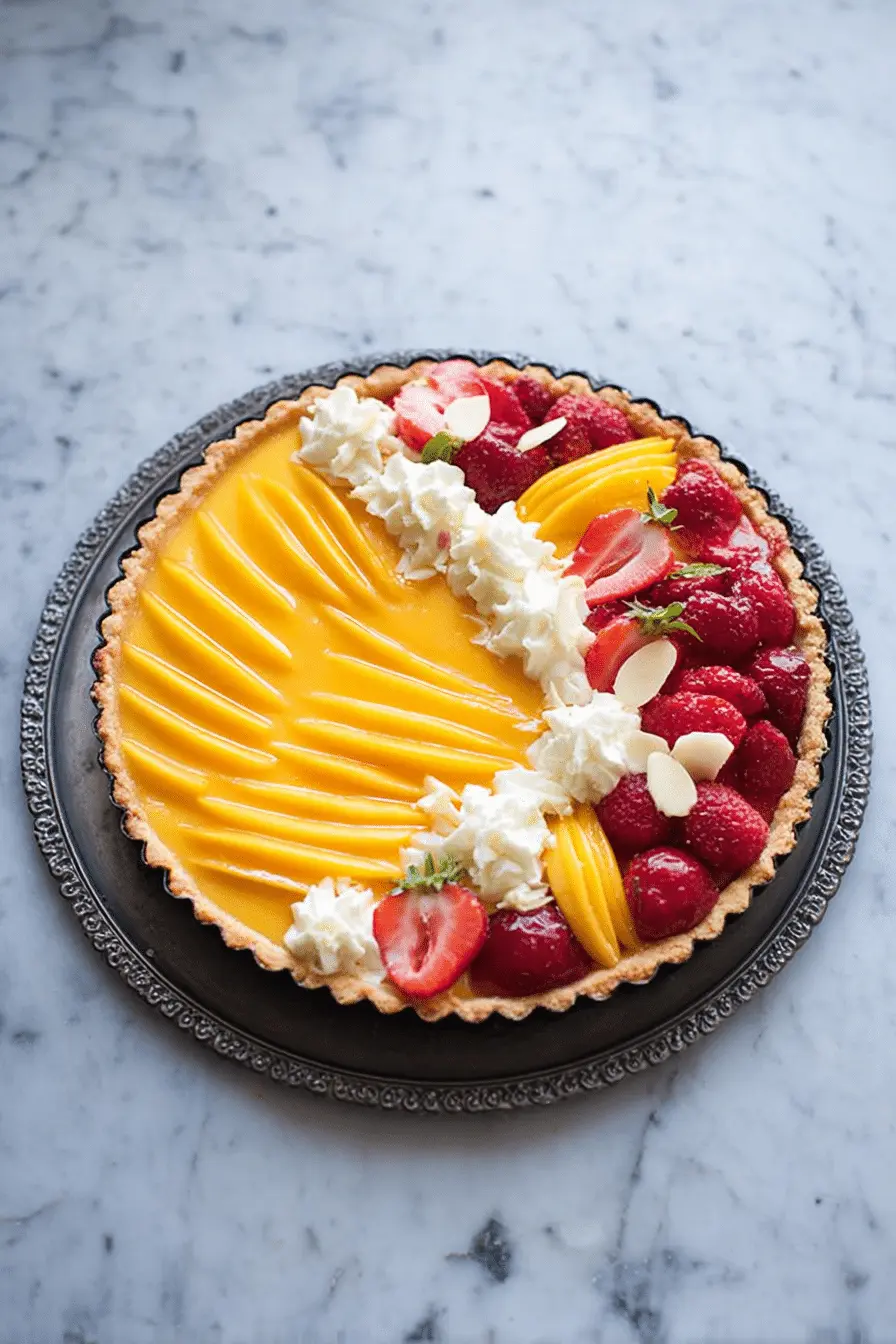
- Garnish and serve:Top the chilled tart with thinly sliced mango, raspberries, and halved cherries. Whip cream to medium peaks with a tablespoon confectioners' sugar and either pipe or spoon it onto the tart. I like to save some cream to serve on the side. Texture and mouthfeel: the curd should be thick, glossy and slow-moving — not runny, not stiff. The crust should be crisp and buttery against the silky curd, and the fresh fruit should add a clean, juicy contrast.
No-Bake Mango Curd Tart Variations
For a true no-bake tart, you can use the same mango curd (made over the double boiler) and let it set in the chilled crust, or you can use gentle thickening agents to avoid eggs entirely. Popular no-bake options include using a cornstarch-thickened mango filling, or setting with gelatin or agar for a firmer, spoonable texture. Pair mango with coconut for a tropical vibe or a thin layer of dark chocolate beneath the curd for a sweet- bitter contrast. If you enjoy no-bake treats, check out our no-bake pumpkin cheesecake balls for another easy dessert option.- Try a graham cracker or digestive crumb crust for a quick no-bake shell — press the crumbs into a tart pan and chill until firm.
- Use almond flour + melted butter for a gluten-free, nutty crust that pairs beautifully with mango.
- Add a thin smear of dark chocolate on the cooled crust before pouring the curd for a layered flavor experience.
Nutritional Adaptations: Vegan and Gluten-Free Options
I frequently make this tart for friends with dietary needs and have several reliable swaps that keep much of the flavor and texture intact.- Vegan curd approach – replace the egg yolks with a thickening agent: use full-fat coconut milk, a bit of cornstarch slurry cooked with the mango puree, and vegan butter for richness. Another route is to make a coconut-mango pastry cream using silken tofu or blended cashews as the base for creaminess.
- Egg-free setters – gelatin works well for a firm set (not vegan). For vegan gel-setting, agar-agar is the go-to. Both need precise blooming and heating — agar sets more firmly and faster than gelatin.
- Gluten-free crusts – almond flour or a gluten-free flour blend replaces all-purpose flour. Expect a slightly more crumbly, tender shell; pressing the dough into the pan (rather than rolling) helps achieve even thickness.
Creative Serving Suggestions and Garnishes
Presentation makes a simple tart feel special. For an elegant dinner, place the tart on a rustic wooden board and slice with a hot, dry knife for clean edges. For parties, cut into small wedges and top each with a tiny spoon of whipped cream and one jewel-like raspberry. Try serving this tart alongside a slice of layered lemon poppy seed pudding cake for an impressive dessert spread.- Fresh mint leaves or edible flowers add color and a hint of herbal brightness.
- A spoonful of passion fruit pulp drizzled over the mango adds textural crunch (those tiny seeds) and a tart lift.
- To create color contrast, arrange thin mango slices in a fan, then dot with raspberries and a few halved cherries for jewel tones.
Tips for Making Individual Mango Tartlets
Mini tarts are charming and great for parties — everyone gets their own portion and they look lovely on a dessert plate. When I make tartlets I like to prepare a batch of dough and freeze extra disks so I can press them into mini pans quickly. For those who love individual desserts, consider making mini lemon meringue tarts as well; they are a delightful alternative!- Use a small round cutter to portion dough; press into tartlet tins rather than rolling to preserve edges.
- Baking times are shorter — watch them closely and start checking earlier. Also remember the curd will set faster in a smaller volume when chilled.
- Customize each tartlet with different fruits or a tiny dollop of flavored whipped cream (coconut for a tropical set, or lime zest for punch).
Storage, Make-Ahead, and Real-World Tips
I often make the curd a day or two ahead — it keeps beautifully in the fridge and tastes even more integrated after a rest. Pour chilled curd into the shell and bake or chill to finish when you’re ready to serve. Leftovers keep well for up to 3 days refrigerated; add whipped cream just before serving. Practical note: the curd thickens as it cools, so don’t overcook it on the stove. If you remove it from heat and it seems a little loose, it will firm in the fridge. If you undercook it, return it to the double boiler and stir until it thickens; patience is the key.Conclusion: Enjoying the Taste of Mango All Year Round
Mango curd tart is one of those desserts that feels like summer but travels well through the seasons. Bright, silky, and delightfully easy to adapt, it’s a recipe I reach for when I want something that’s simultaneously festive and refreshingly light. Make it baked for a classic finish or chilled for a simpler no-bake version; either way, the lime and mango pairing is reliably satisfying. Don't forget to explore other sweet delights like our delicious banana bread for more dessert options.FAQ
Can I use frozen mango puree instead of fresh mango? Absolutely! Frozen mango puree works well and can save you time. Just make sure it's fully thawed and smooth before using it for the curd. How do I know when the mango curd is thick enough? The curd should coat the back of a spoon and hold a line when you run your finger through it. This usually happens when it starts to thicken over the double boiler. Can I make the tart crust ahead of time? Yes! You can prepare the tart crust a day in advance. Just wrap it tightly in plastic wrap and store it in the fridge until you’re ready to bake. Is it possible to make this tart gluten-free? Yes, you can substitute the all-purpose flour with a gluten-free flour blend or almond flour for the crust to make it gluten-free. How should I store leftover mango curd tart? Store it in an airtight container in the refrigerator for up to 3 days. Just be sure to add any whipped cream right before serving!Recipe Card
Mango Curd Tart: A Refreshing Tropical Dessert for Any Occasion
- Prep
- 30 min
- Cook
- 40 min
- Total
- 80 min
- Serves
- 8
- Calories
- 300 kcal
Ingredients
- 1/4 cupalmond meal or flour
- 1 1/4 cupsbleached all-purpose flour
- 1/2 cupconfectioners' sugar
- 1 pinchsalt
- 10 tbspsoft butter
- 1large egg yolk
- 1 1/4 cupscanned mango puree
- 1/4 cuplime juice
- 1/3 cupsugar
- 6egg yolks
- 4 tbspunsalted butter
- 2mangos (peeled and sliced thin)
- 1 cupraspberries
- 1 cuppitted, halved cherries
- 1 cupwhipped cream
- 1 tbspconfectioners' sugar
Instructions
- 1
In a Stand Mixer, cream the butter and sugar with the Beater Blade. Then add the yolk and mix to combine. Add the flour and salt, blend until it comes together.
- 2
Press the dough into a 9 to 10-inch Tart Pan with Removable Bottom or form the dough into a disk and refrigerate for at least an hour.
- 3
Roll out the dough and transfer it into the tart pan, pressing to fit.
- 4
Freeze the dough for about 15 minutes while preheating the oven to 350°F.
- 5
Fill the tart shell with foil and baking beans or pie weights. Bake for about 20 minutes.
- 6
In a bowl set over a double boiler, mix together the mango, lime, sugar, salt, and yolks. Stir to thicken, then add butter and strain the curd.
- 7
Pour the curd into the prepared tart shell and bake at 325°F until set (15-35 minutes depending on temperature of curd). Cool to room temperature and refrigerate until well chilled.
- 8
Garnish with sliced mango, raspberries, and cherries.
- 9
Whip cream to medium peaks and pipe over the curd. Serve remaining cream with sliced tart.
You might also like
Reviews
Be the first to review this.