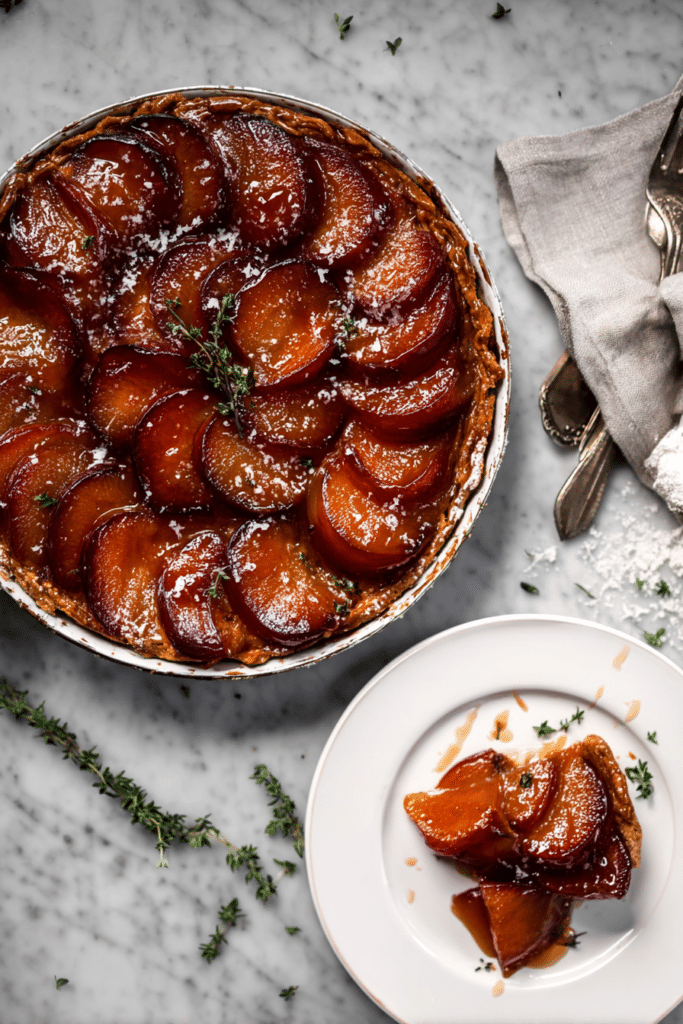
I’ve made more tarte tatins than I can count, and the plum and thyme version is one I return to when I want something both humble and showy. In my kitchen the flip is the moment that makes guests hush — glossy, caramelized plum halves fanned beneath a golden, flaky top. I love how the herbal lift of thyme keeps the sweetness from becoming cloying; it smells like late summer and fireside afternoons.
There were mistakes along the way: a caramel that ran too thin because I pulled it off the heat too early, a pastry that shrank because the butter warmed in my hands, and fruit that turned to mush because it was overcooked. Each mistake taught me one simple truth — patience and temperature are everything. When you mind those two things, this tart rewards you with a jammy center and layered, buttery pastry.
In this piece I’ll walk you through what matters most for success: the precise way to coax a silky, spoonable caramel, how to judge plum ripeness, why your butter must stay cold, and a clear sequence for building and baking the tart. I wrote it from my hands-on experience in a home kitchen so you can feel confident and prepared when you make it.
Expect rustic imperfect beauty, comforting aromas of browned butter and thyme, and a tart that looks like it came from a neighborhood bakery rather than a textbook. Keep your temperament steady, and I’ll share the small moves that turn a good tarte tatin into one worth making again.
Everything You Need for Plum & Thyme Tarte Tatin
Before you begin, gather ingredients and tools so you won’t be scrambling while a caramel reaches color. Below I explain roles and sensible substitutions so you know why each element matters.
- Plums – The star fruit; choose plums that are ripe but still hold shape. If overly soft, they will release too much juice into the caramel.
- Fresh thyme – Adds aromatics that cut through sweetness; fresh is preferred for brightness, dried can be used sparingly.
- Butter – Gives richness to both the caramel and the pastry; use a butter with good flavor for the best result.
- Sugar – For the caramel base; plain granulated sugar is ideal for predictable melting.
- Heavy cream – Makes the caramel silky; warm the cream slightly to reduce splatter when combined with hot sugar.
- Salted butter (for caramel) – Adds savory balance; if you use unsalted, add a pinch of salt.
- All-purpose flour – For the puff pastry dough; if you prefer convenience, store-bought puff pastry can work in a pinch.
- Cold water – Keeps the dough cool and workable; cold liquid prevents the butter from softening during mixing.
- Equipment – A heavy skillet for caramel cooking, a tart pan (sturdy, with a lip), a rolling surface, a bench scraper, and a reliable oven. A thermometer is useful if you want precise caramel temperatures.
The Secret to Silky, Spoonable Caramel
Caramel flavor comes from controlled browning reactions — sugars breaking down and forming deeper flavor compounds. You want a rich amber color that smells toasty and a texture that stays pourable when warm. A few techniques made all the difference for me.
- Start with dry sugar in a wide pan so melting is even; resist stirring in the early stage and instead swirl the pan gently to move unmelted crystals into the melt.
- Watch for color, not time. When the sugar reaches a medium amber, remove it from direct heat before adding cream to avoid burning the sugars.
- Cool the pan off the heat for a few seconds and then slowly add the warm cream while whisking; this prevents violent bubbling and keeps the caramel smooth.
- Finish with butter and a pinch of salt for a glossy, spoonable consistency; if the caramel thickens too much as it cools, rewarm gently to loosen.
For an extra touch of flavor, try making homemade caramel that pairs wonderfully with desserts.
Why Plum Ripeness Changes Cook Time
Plum ripeness dramatically affects how the fruit behaves under heat. I always feel the plums before I cook: a ripe plum yields slightly under gentle pressure but still keeps structure. Overripe plums will collapse and release too much juice; underripe fruit won’t properly caramelize.
- Ripe plums release more juice, so the cooking time to set the caramel will be shorter; watch for jammy edges.
- Firmer plums need a few extra minutes in the caramel to soften and pick up color; you want fruit that holds its shape after baking.
- Visual signs: even color, slight give when pressed, fragrant aroma. Use those cues rather than calendar date.
Why Butter Temperature Makes or Breaks Your Pastry
Cold butter is the secret to those distinct, flaky layers. When butter is in solid pieces inside the dough, the water within it creates steam in the oven and lifts the layers apart. If your butter softens too much while working the dough, the layers merge and the pastry becomes dense.
- Work quickly and keep the dough cool between folds; chill the dough if your kitchen warms up.
- If you see butter smearing into the flour rather than remaining as bits, stop and chill — that means it’s too warm.
- Book folds and letter folds help create many thin layers; patience with resting times ensures the butter stays solid until baking.
Understanding the importance of butter temperature can be crucial in achieving the perfect pastry.
Pro Tip for plum & thyme tarte tatin: Timing the Caramel and Fruit
- I look for a medium amber caramel — not pale, not dark — which gives deep flavor without bitterness.
- Use color as your cue: a warm chestnut tone and a toasty aroma signal readiness.
- Test plums for doneness in the caramel by nudging one half; it should soften and pick up a gloss without falling apart.
- If you have a thermometer, aim for the caramel to be in the range where it coats the back of a spoon evenly; this helps ensure the caramel will set attractively after the flip.
- If the caramel darkens too quickly, remove from heat and add cream slowly to stop the cooking process; never try to rescue a scorched caramel — start over for best flavor.
How to Make Plum & Thyme Tarte Tatin (Step-by-Step)
Below is the sequence I follow every time. Read through fully before you begin so each moment at the stove and in the oven is intentional.
- Prepare your pastry dough and keep it chilled while you work on the caramel and fruit.
- Warm the cream with thyme briefly to infuse it; strain out the herb before adding to hot sugar so you keep the caramel smooth.
- Caramelize the sugar in a wide skillet, remove at medium amber, and whisk in the warm cream and butter until glossy.
- Arrange plum halves cut-side down in the skillet or directly in the prepared tart pan if your pan is oven-safe; pack them so they form an even layer.
- Pour the caramel over the plums, then cover with the rolled pastry, tucking the edges carefully down the pan’s lip and cutting vents for steam.
- Bake until the pastry is deep golden and crisp; let the tart cool a few minutes before flipping.
- To invert, hold a serving plate over the pan, flip in one confident motion, and allow the tart to sit so the caramel can settle and release.
Troubleshooting I’ve learned from experience:
- I have learned to wait the brief resting time after baking; flipping immediately will scatter hot caramel and risk burns.
- I once had pastry shrink because I rolled it too thin; if the dough pulls back, it’s usually the result of overworking — chill and re-roll slightly thicker.
- I always keep an extra small saucepan ready with a spoonful of warmed caramel in case the main batch becomes grainy; gentle reheating and whisking usually smooths it out.
What to Serve with Your Tarte Tatin: Pairings & Serving Notes
Serve the tarte warm so the caramel is molten and the plums are at their juiciest. A scoop of vanilla ice cream or a spoonful of lightly sweetened whipped cream is classic for a reason — the cold cream contrasts the sticky caramel. For a tangier balance, crème fraîche is excellent.
- Beverages: late-harvest white wine, amber‑colored fortified wines, or robust coffee all complement the caramel and thyme.
- Garnish simply with fresh thyme sprigs for perfume and visual contrast.
- If you want to present a table of desserts, a fruit-forward companion like a peach cobbler pairs well without competing for attention.
If you’re looking for a fruity dessert option, consider serving a delicious peach cobbler alongside your Tarte Tatin.
How to Store and Reheat Plum & Thyme Tarte Tatin (Make‑Ahead & Leftovers)
Leftovers keep well when you protect texture and flavor. I store mine carefully and reheat so the pastry regains its crispness.
- To store: allow the tart to cool to room temperature, then cover loosely with plastic wrap or place in an airtight container and refrigerate for up to three days.
- To reheat: warm in a moderate oven until the pastry is crisp and the caramel is warmed through. Avoid microwaves for whole slices — they make pastry soggy.
- Creative reuse: spoon cooled tart over yogurt, swirl into hot porridge, or fold pieces into a breakfast pancake batter for an indulgent twist.
Variations for Seasonal Fruits and Herbs
- Apples or pears are classic and more forgiving than plums; choose firm varieties that hold their shape when cooked.
- Stone fruits like peaches or nectarines work beautifully — reduce cooking time slightly to prevent over-softening.
- Swap thyme for rosemary or basil depending on the fruit: rosemary pairs well with apples and pears, while basil can be interesting with peaches.
- If you’d like a different caramel-fruit pairing idea, try a showcase dessert such as a caramel apple eclair cake for a seasonal table addition.
Experiment with seasonal flavors by trying our Caramel Apple Eclair Cake to impress your guests.
Frequently Asked Questions
What can I serve with Plum & Thyme Tarte Tatin?
This delicious tarte tatin pairs wonderfully with homemade whipped cream or a scoop of vanilla ice cream. You can also serve it with a dollop of crème fraîche for a tangy contrast!
Can I use other fruits instead of plums?
Absolutely! You can substitute plums with other seasonal fruits like apples, pears, or peaches. Just keep in mind that different fruits may require slight adjustments in cooking time.
How should I store leftovers?
Store any leftover tarte tatin in an airtight container in the refrigerator for up to 3 days. To reheat, place it in the oven at a low temperature until warmed through.
What should I do if my caramel is too hard?
If your caramel turns out too hard, you can add a splash of water and gently reheat it on the stove until it softens again. Stir continuously to achieve a smooth consistency.
Do I have to use fresh thyme, or can I use dried thyme?
While fresh thyme is recommended for the best flavor, you can use dried thyme in a pinch. Just remember that dried herbs are more concentrated, so use about one-third of the amount of dried thyme compared to fresh.
Plum & Thyme Tarte Tatin
Ingredients
Method
- Add the flour and salt into a medium sized bowl and stir around with your fingers to mix.
- Add your cold cubed butter to the bowl and toss to cover in flour.
- Gently squish each cube with your fingers to flatten slightly. Don't over work too much, we want to keep the butter in fairly big chunks.
- Slowly start adding your cold water, about a TBSP at a time. Gently toss the dough with your fingers. Don't over mix.
- Once all of the dough starts to stick together and there aren't any large dry patches, pull it out onto your floured work top and shape into a square.
- Roll out the dough into a long rectangle. Brush off the excess flour and do your first letter-fold.
- Rotate your dough, so the open ends are at the top and bottom and repeat the letter fold.
- Rotate again, and do your first book fold.
- Wrap the dough in plastic wrap and let rest in the fridge, while you prep the rest of your ingredients.
- Preheat the oven for 205°C (400°F).
- Cut the plums in half and discard the core. Generously butter your tart pan.
- In a small sauce pan, add the cream and sprigs of thyme. Bring to a simmer.
- In a large skillet, add the sugar and bring to medium high heat to caramelize.
- Let the sugar continue to melt and starts to color until it reaches a medium amber color.
- Strain the cream into a bowl and discard the thyme.
- Once the caramel is ready, whisk in the cream, followed by the cubed salted butter until completely combined.
- Transfer your plum halves to the caramel, cut side down, and cook for about 10 minutes.
- Roll out your puff pastry to a circle slightly larger than your tart pan.
- Transfer the dough to the top of the plums and tuck in the edges.
- Cut vents in the pastry dough for steam to escape.
- Bake for 45 minutes or until the dough is golden brown and flaky.
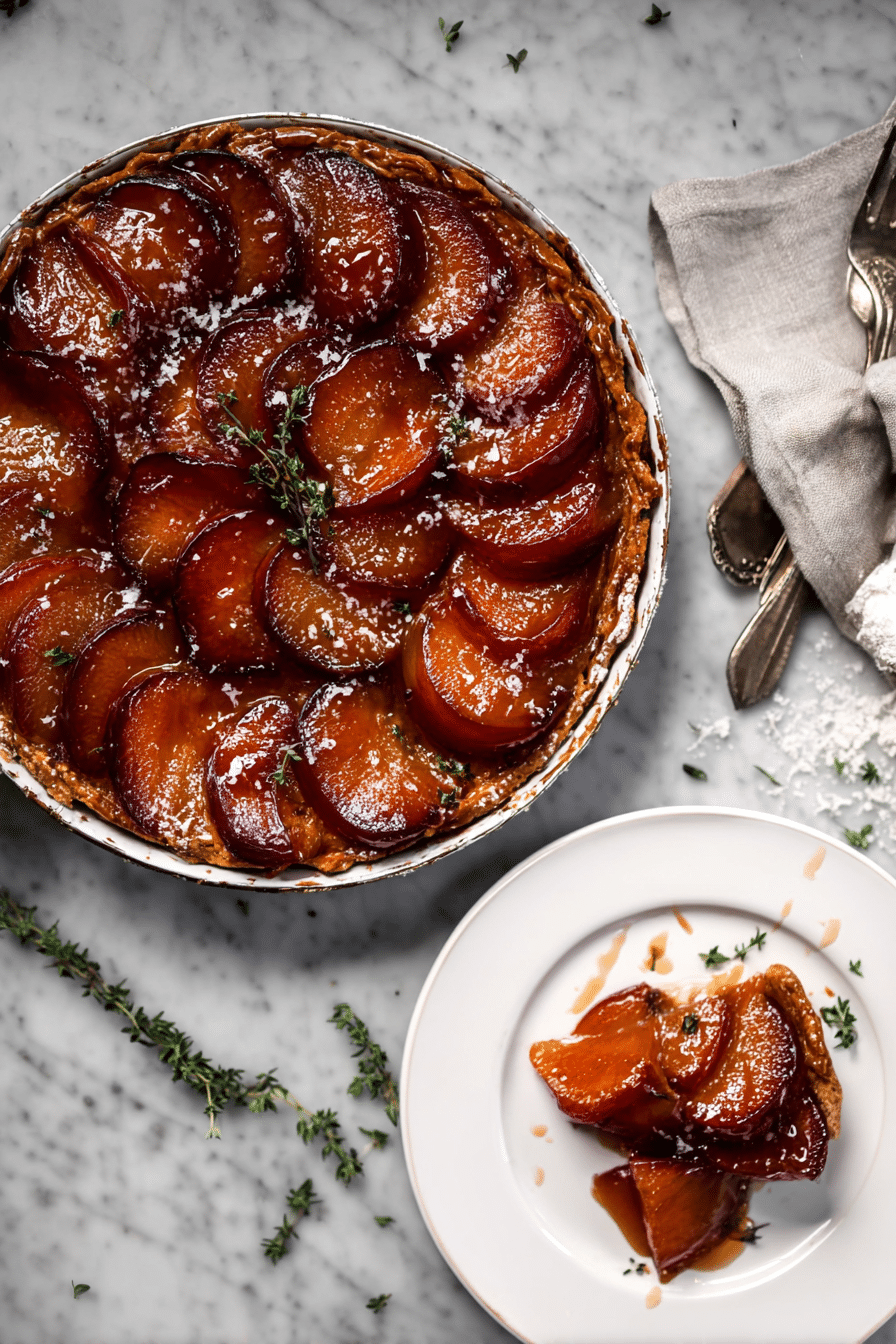
- Allow to cool, then flip out onto a serving dish and garnish with fresh thyme.